HomeArcadeStories AcademyCommunity
โ˜… THE DUGOUT LIBRARY โ˜…

Stories From
the Diamond

Baseball is a game you can love for a lifetime and still keep learning. Pull up a seat in the dugout โ€” Dinger's got stories.

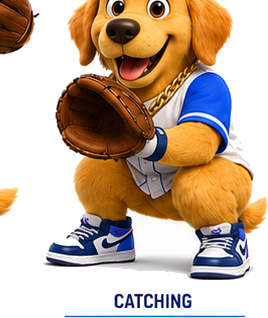
Dinger Dog catching
โšพ

Why Is a Home Run Called a "Dinger"?

Language of the game ยท 4 min read

Baseball has more slang for the home run than any other play in sports: dinger, moonshot, blast, bomb, tater, big fly, going yard. "Dinger" most likely grows out of the old sense of "ding" โ€” to strike something hard and make it ring. When a ball comes off the bat with that unmistakable crack, it's been dinged in the most satisfying way possible, and by the late twentieth century "dinger" had settled into broadcast booths and dugouts as everyday shorthand.

The richness of home run slang says something about the sport itself. Baseball is a game of long quiet stretches punctuated by sudden thunder, and fans have always reached for colorful language to capture the play that changes everything with one swing. A "moonshot" flies high, a "laser" flies flat, a "walk-off" ends the game on the spot โ€” each word carries its own picture.

๐Ÿพ Dinger's take: our mascot answers to the sound of a bat barrel finding a fastball. That's the whole origin story.
๐ŸŽถ

The Seventh-Inning Stretch: Baseball's Built-In Singalong

Traditions ยท 5 min read

Midway through the seventh inning, everything pauses. Tens of thousands of strangers stand up, stretch their legs, and sing together. No other major sport has anything quite like it. The custom of standing in the seventh is well over a century old โ€” crowds in the 1800s were already rising late in games to shake off wooden-bleacher stiffness โ€” and it eventually fused with a song written in 1908 by Jack Norworth and Albert Von Tilzer: "Take Me Out to the Ball Game."

Here's the tradition's best joke on itself: the song everyone sings at the ballpark is actually about someone begging to be taken to the ballpark, and by most accounts Norworth hadn't attended a big-league game when he wrote it. It didn't matter. The chorus was easy, the tune was catchy, and by the time broadcaster Harry Caray began leading Chicago crowds in it during the 1970s and '80s, the singalong had become as much a part of the game as the ball itself.

๐Ÿ’ก Dugout detail: the lyric "buy me some peanuts and Cracker Jack" is one of history's most successful accidental jingles โ€” the snack predates the song, but the song made it immortal.
๐Ÿงค

From Bare Hands to Basket Webs: The Evolution of the Glove

Gear ยท 5 min read

Early baseball was played bare-handed, and catching a line drive was as painful as it sounds. When players in the 1870s began experimenting with thin leather gloves, some were mocked for it โ€” toughness was part of the ethos. The turning point came when respected stars adopted them anyway, choosing functioning fingers over bravado, and by the 1890s gloves were standard equipment.

The next century was a slow arms race of design. Padding grew. A web appeared between thumb and forefinger, turning the glove from a shield into a trap. Lacing connected the fingers. Specialized models emerged โ€” the catcher's mitt built like a mattress, the first baseman's long scoop, the outfielder's deep pocket, the middle infielder's small, quick glove built for fast transfers on the double play. The modern glove is so effective that plays which would have been miracles in 1900 are now routine outs.

๐Ÿงค Break-in ritual: ballplayers still argue about the right way to break in leather โ€” glove oil, mallets, sleeping on it. Ask three infielders, get four answers.
๐Ÿ”ข

Why a Double Play Is Called a "6-4-3"

Inside the game ยท 4 min read

Every defensive position in baseball has a number, and once you learn the code, box scores start talking to you. The numbering runs: pitcher 1, catcher 2, first base 3, second base 4, third base 5, shortstop 6, left field 7, center field 8, right field 9. The system exists for scorekeeping โ€” every out can be written as the sequence of fielders who touched the ball.

So the classic ground-ball double play โ€” shortstop to second baseman to first baseman โ€” is a "6-4-3." A fly out to center is a simple "8." A strikeout is a "K" (and a called third strike is a backwards K, one of scorekeeping's best flourishes). The quirk everyone notices: the shortstop is 6 rather than 5, because the numbering was set when shortstops played more like a fourth outfielder than a fixed infielder, and the label simply stuck.

๐Ÿ““ Try it: keep score by hand at one game โ€” even on a napkin. It's the fastest way ever invented to learn baseball's rhythm.
๐ŸŸ๏ธ

Mascots and the Fine Art of Ballpark Joy

Culture ยท 4 min read

Baseball's pace leaves room for personality, and no one fills that room like a mascot. The modern era of furry chaos took off in the 1970s, when costumed characters proved that between-innings entertainment could become a beloved part of a team's identity โ€” firing t-shirt cannons, taunting rival dugouts, dancing on top of them, and adopting whole cities in the process.

What makes a great mascot isn't the costume; it's commitment. The best ones develop running bits with umpires, signature celebrations for home runs, and genuine bonds with the kids in the front rows. A mascot is permission for a stadium full of adults to be silly, and that permission is worth more than any scoreboard graphic.

๐Ÿ• Obviously: Dinger Dog studied all the greats. His signature move โ€” the post-homer bat-drop-and-zoomies โ€” is patent pending.